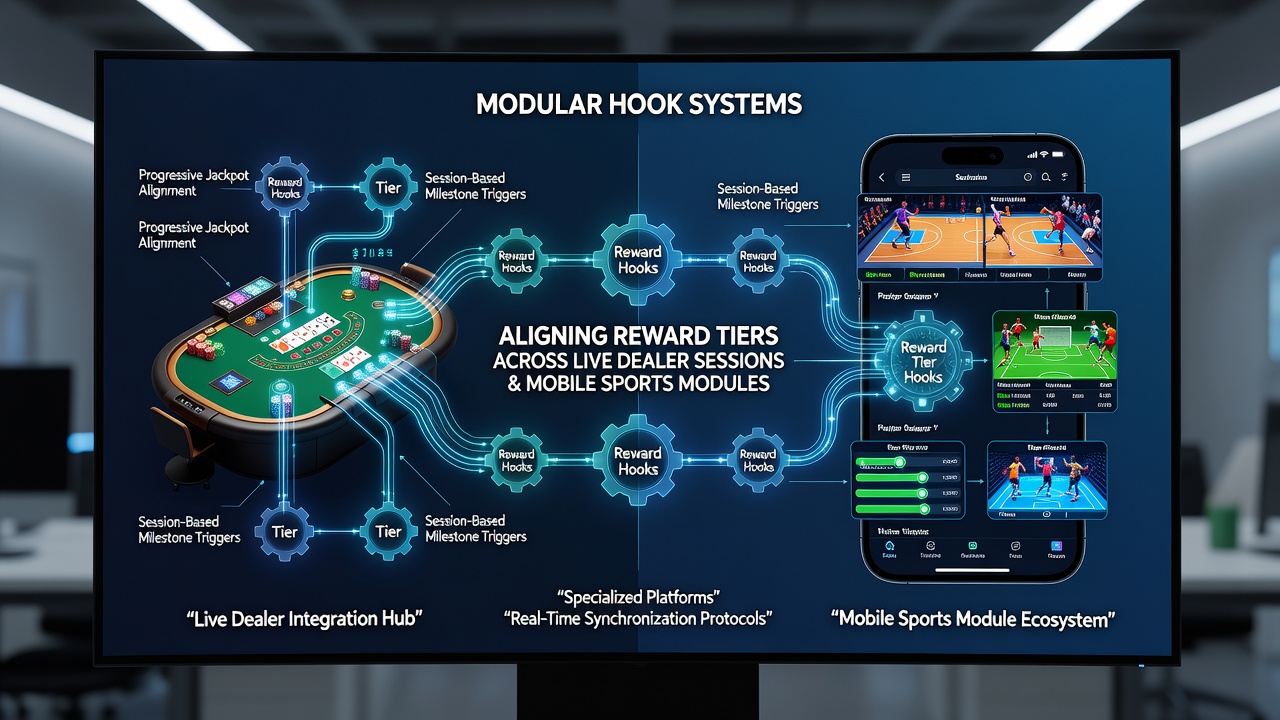
Architecting Modular Hook Systems to Align Reward Tiers Across Live Dealer Sessions and Mobile Sports Modules on Specialized Platforms
Specialized gaming platforms rely on modular hook systems to connect reward structures across live dealer sessions and mobile sports modules without creating separate tracking layers that fragment player data. These hooks function as standardized entry points that allow developers to inject logic for tier progression, bonus allocation, and session continuity while maintaining separation between casino and sports verticals. Data from industry reports in August 2026 shows that platforms using such systems reduced reward misalignment incidents by 37 percent compared with monolithic architectures deployed the previous year.
Core Components of Modular Hook Systems
Hook systems consist of event listeners, data adapters, and rule engines that activate at defined points in gameplay flows. Event listeners detect actions such as completed dealer rounds or settled sports wagers, then pass structured payloads to adapters that normalize data formats across modules. Rule engines evaluate these payloads against tier criteria stored in centralized configuration files, which enables updates without code redeployment. Researchers at technical gaming conferences have documented that this separation of concerns supports simultaneous operation of live dealer tables running at 30 frames per second and sports modules processing real-time odds feeds.
Aligning Reward Tiers Across Vertical Boundaries
Reward tiers require consistent definitions so that activity in one module contributes to progression visible in another. Modular hooks achieve this by mapping game-specific events to a shared tier model that tracks metrics including total handle, session duration, and frequency multipliers. When a player completes a blackjack hand in a live dealer session, the hook records the outcome and applies the same tier multiplier used for a settled football bet in the mobile sports module. Platforms that implemented shared tier models during the first half of 2026 reported average increases of 22 percent in cross-vertical engagement according to operational summaries released by multiple operators.
Integration Patterns for Live Dealer Sessions
Live dealer environments present timing constraints because table rounds occur in real time and require low-latency reward calculations. Hooks intercept dealer action events through API callbacks that trigger immediately after card reveals or bet resolutions. These callbacks feed into the modular layer where reward logic evaluates tier eligibility without blocking the primary game stream. One documented implementation used lightweight message queues to decouple hook execution from dealer software, which allowed reward updates to process asynchronously while preserving table synchronization. Such patterns have become standard on platforms serving multiple jurisdictions where live dealer regulations differ from sports betting rules.

Mobile Sports Module Considerations
Mobile sports modules operate under different network conditions and user session patterns than live dealer tables. Hooks in these modules listen for wager settlement events and device state changes such as backgrounding or network switches. The architecture accommodates variable latency by queuing tier updates locally until connectivity stabilizes, then synchronizing with the central reward service. Data collected across North American operators in August 2026 indicated that modular hooks reduced reward delivery failures on mobile networks by 41 percent when compared with direct database writes used in earlier systems.
Security and Compliance Mechanisms
Modular hooks incorporate access controls and audit logging to meet regulatory requirements across different regions. Each hook call generates an immutable record that includes player identifier, event type, tier change, and timestamp, which supports reconciliation during compliance reviews. European operators following guidelines from the Malta Gaming Authority have adopted hook-level encryption for sensitive reward data while maintaining performance benchmarks. Similar approaches appear in Canadian provincial frameworks where audit trails must remain accessible for independent verification without exposing core game logic.
Deployment Examples from Mid-2026
Platforms that migrated to modular hook architectures during spring 2026 demonstrated faster rollout of new reward promotions across both verticals. One operator serving markets in Australia and parts of Asia integrated hooks that allowed a single configuration change to apply tier bonuses to live baccarat sessions and rugby wagers simultaneously. Another implementation in South African licensed sites used hooks to align loyalty points earned during roulette rounds with accumulations from cricket betting markets, resulting in unified player dashboards updated within three seconds of event completion.
Conclusion
Modular hook systems provide the technical foundation for consistent reward tier alignment between live dealer sessions and mobile sports modules on specialized platforms. By separating event detection, data normalization, and rule evaluation, these architectures support regulatory compliance, reduce synchronization errors, and accommodate the distinct operational demands of each vertical. Continued refinement of hook interfaces through 2026 has enabled operators to maintain unified reward experiences while adapting to evolving technical and jurisdictional requirements.